
18XX. This trend continued strong, with 16 plays of various 18XX titles. I was very happy with this. Now that we have over 30 plays with this group, I did some stats of the results. The most active players in our group (me, Aapo and Ville), do equally well: our average scores are 83-84% of the winner’s score in the game. The best player in our group, the other Ville, has an average of 93%. My son is also above 90%. This matches my expectations fairly well.
Forest Shuffle. I thought Forest Shuffle might be the first game to reach 500 plays and that might happen in 2025, but it didn’t. It’s close enough that it will happen in 2026.
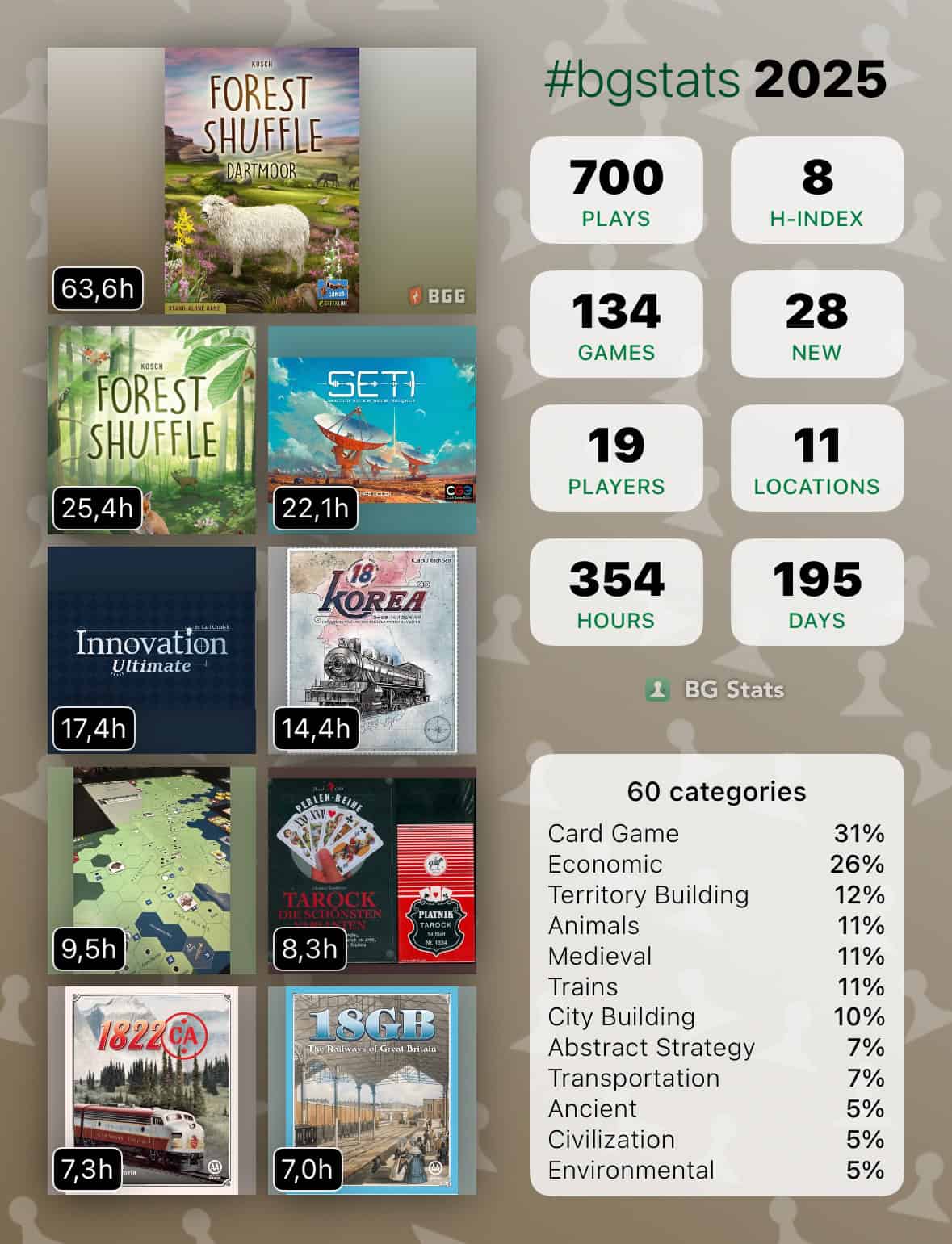
A decline in live plays, growth in digital. I played more games in 2025 than in 2024 (700 vs 652), but the total time spent was lower (~350 hours vs ~380 hours). If I exclude digital games (mostly Forest Shuffle on BGA), 2025 was not as good (378 plays and ~270 hours vs 471 plays and ~330 hours). That’s not a huge surprise: my son moved out in February, and the time spent playing games with him went down a lot.
No more Magic. I decided to stop playing Magic: The Gathering on Arena. I finally decided it’s a time sink. It was something I had to do to grind the daily quests, and wasn’t always fun. Keeping up with the new stuff started to feel exhaustive. I also sold most of my paper Magic – somebody got a nice deal of ~6,000 random cards for a 50 €. I kept my draft cube and a Battle Box; those will do just fine if I ever want to play Magic.
New poker chips. I’ve had my Venerati poker chips for almost 20 years. I got a box of 100 Iron Clays for board game use at some point, and recently we’ve used a bigger Iron Clays set my friend has for 18xx use. This year, I bought a set of Ruben’s Mini Chips for 18xx games. The more compact chips are awesome.
Darts instead of go. In 2024, I had semi-regular go games before our game nights for a while. In January 2025, I thought trying darts might be fun. Now three or four of us meet every week to play darts before our board games. We’re still not particularly great, throwing doubles is a bit of a struggle for all of us.
Game of the Year 2025
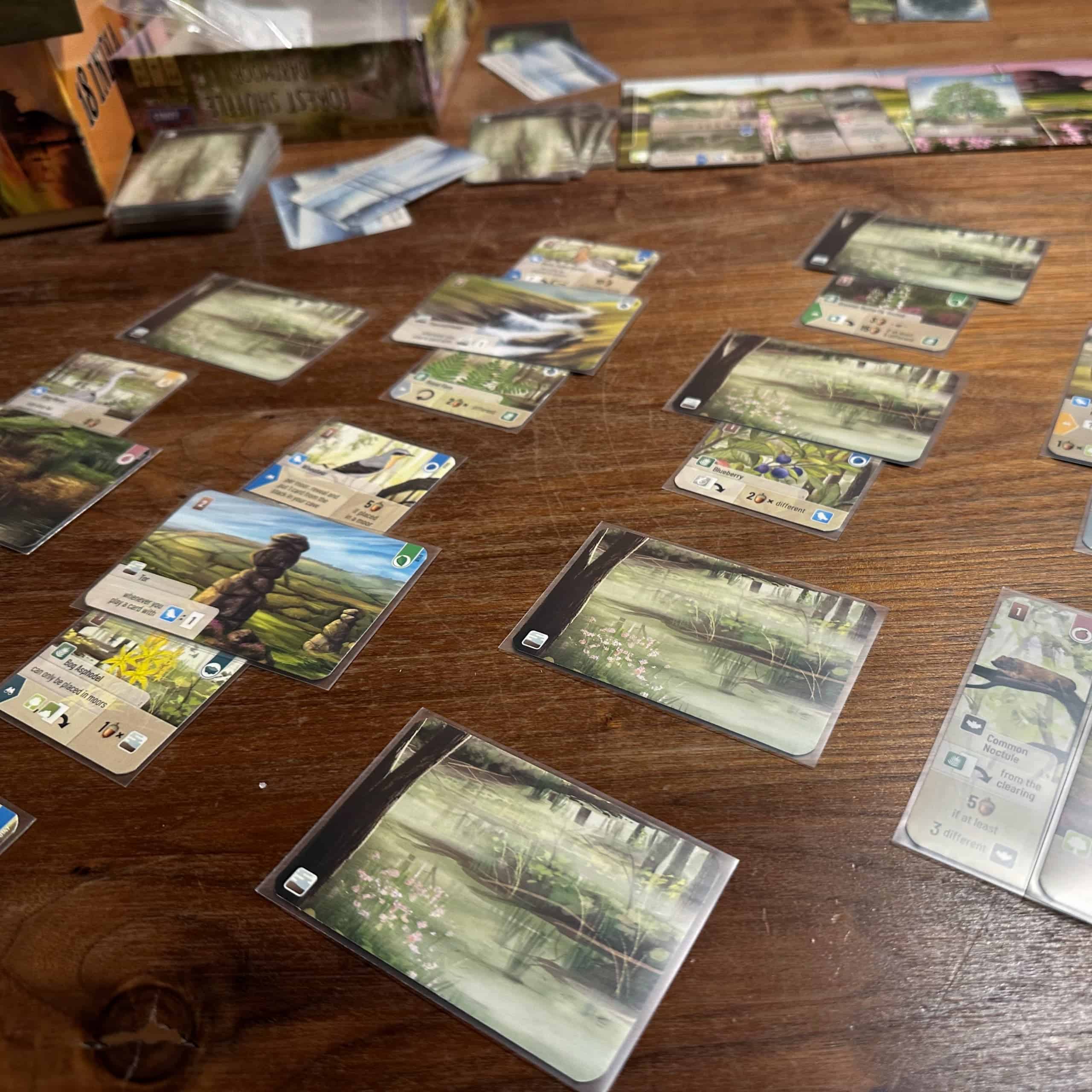
Forest Shuffle: Dartmoor is, by far, my favourite new release in 2025. With well over 200 plays and over 60 hours, mostly at Board Game Arena, it’s my most played game. I didn’t have huge expectations for it – I thought I would give it a go to see how it’s different from the original. It turned out to be a huge hit for me. I also learnt the best strategy for the game well enough to reach the top 10 in ELO rankings on BGA.
Dartmoor is sufficiently different from the original. It seems somewhat better balanced. There’s a best strategy, yes, but it’s wider than the main strategies in original Forest Shuffle. You need to hit certain key things, but beyond that, there are many things you can do, and you have to find your way depending on the cards you get. That’s more interesting than just hoping to get the deer.
Also, Dartmoor is much more of an engine builder than the original. The original featured hardly any engine building, and even with both expansions, there aren’t many cards that can feed a strong engine. Dartmoor is all about the draw engines, and I think that’s a missed opportunity at BGA: the game doesn’t track how many extra card draws a player gets. That would be an interesting statistic, and I’m sure it would have a very strong correlation with success.
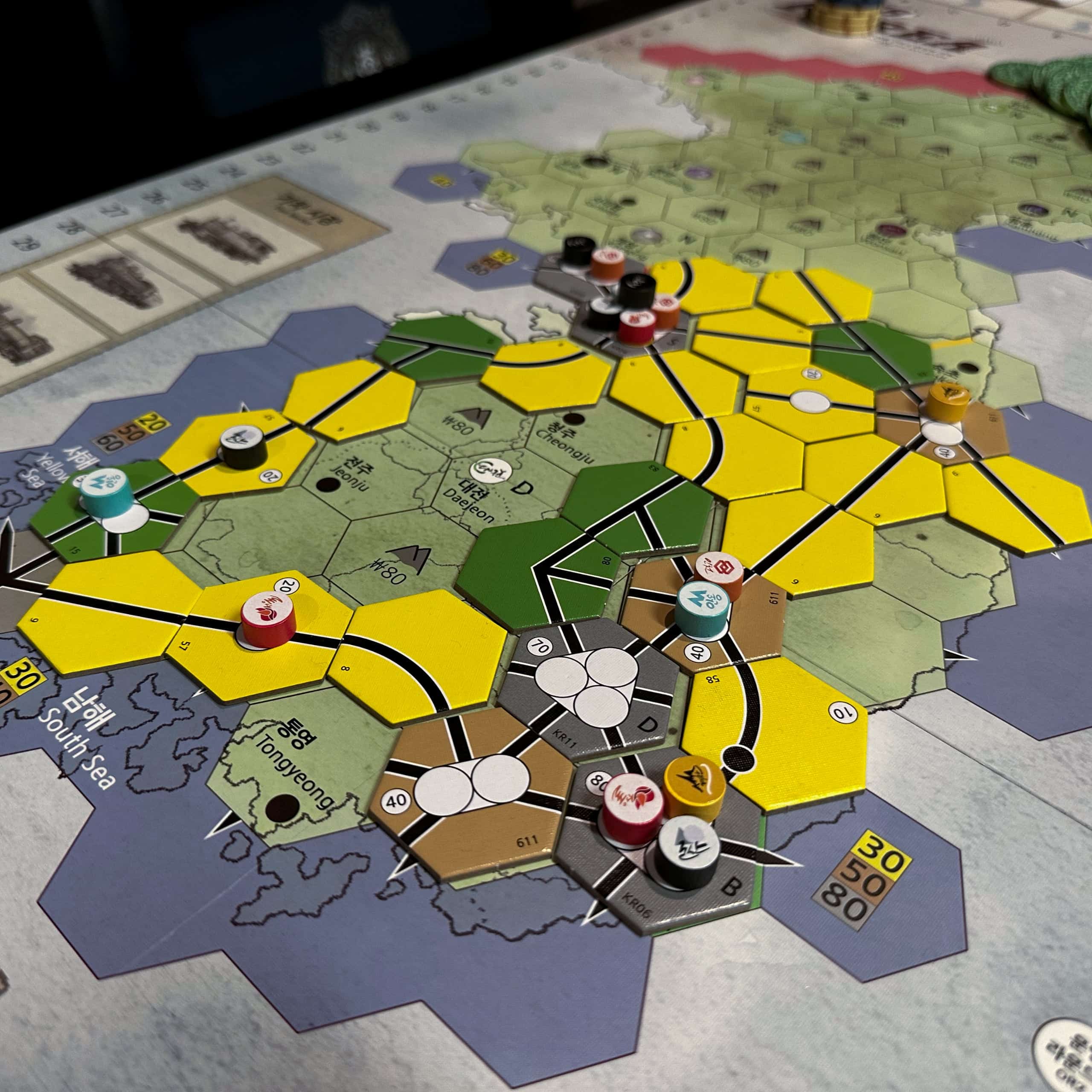
Heavy Game of the Year. 18Korea. The train game people in Helsinki have been raving about 18Korea for a while. Despite the upcoming crowdfunding for the new English edition, I went and bought the Korean edition. It was expensive, but worth it: 18Korea is a lot of fun. This 18xx game is set in Korea and for starters features the Korean War: at the middle of the game the war breaks out, everything in North Korea is lost and all the cities in South are destroyed. The players also have very strong special powers they can assign to their companies. It’s weird, highly replayable thanks to a dynamic setup, and a lot of fun. We played the game five times and saw a wide array of outcomes.
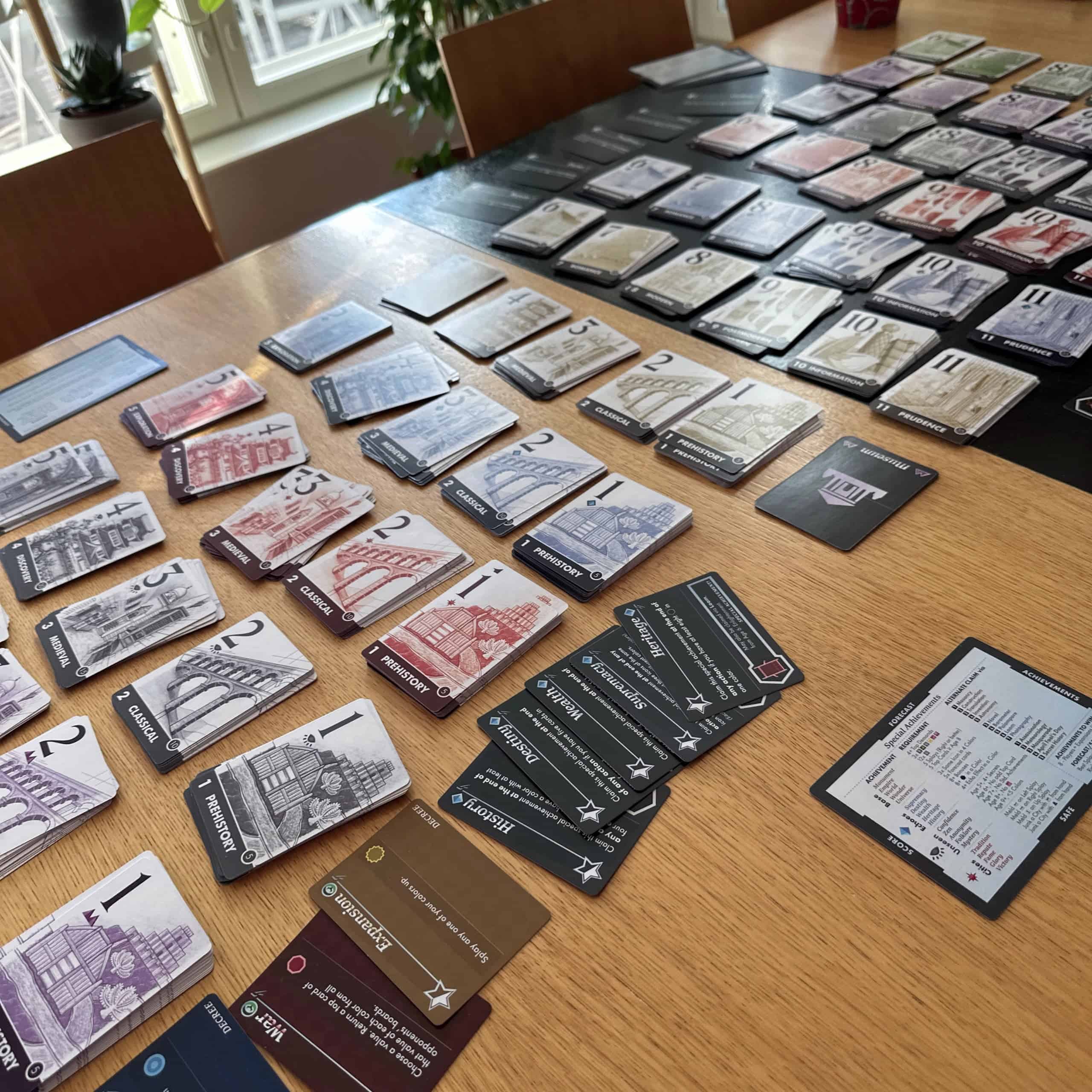
Medium Game of the Year. Innovation Ultimate. I’ve been a long-time fan of Innovation – I still have my first-edition copy, patched to third edition – but I haven’t given much thought for the expansions. The Innovation Ultimate kickstarter arrived in Spring and lead to a boom of Innovation play, and this time with the expansions. While the base game is great and easily good for 100+ plays any time, the expansions have been a lot of fun.
We’ve even played a couple of games with all the expansions at the same time. That’s feasible and crazy, but if you’re interested in trying it, I recommend doing that on Yucata, as having a computer keep track of all the rules is very helpful when you have all the expansions. Running two expansions at the time is easy.
Good new games (2024–2025)
Botanicus. This was released in Finnish by Lautapelit.fi. My friend who works as the Lautapelit.fi store manager taught me the game. I would’ve passed this otherwise, but I’m glad I didn’t – this is a fun little game. I’ve played it twice and won both times, so obviously I’m biased.
The Fellowship of the Ring: Trick-Taking Game. Co-op trick-taking meets The Lord of the Rings? Sure, why not: when Asmodee offered a review copy, I took it. I still haven’t finished the campaign and I’m not sure if I will, it was a good fun for five hours and ~60 plays. It’s not as good as The Crew and mostly easier than it, but there are some difficult chapters, too.
Galileo Galilei. I got to try this game once, and enjoyed it. Unfortunately, it was owned by the friend who has a tendency to sell games very swiftly, and I never got a chance to play this game again. It’s not SETI or even Tea Garden, but I would’ve liked to explore it further after taking the effort to learn it.
The Lord of the Rings: Duel for Middle-Earth. The more popular Lord of the Rings game from 2024. I can see why this is popular and I think it mostly does good things for the 7 Wonders Duel format. I enjoyed my plays and would happily play this if someone else wants to play it.
Luz. This is originally from 2013, but I played the 2024 edition. In this trick-taking game you only see the colours of your cards and show the values to other players. The people in my game group seem to hate this, but my other group enjoyed it. I’d like to play this a little more to see where I fall, but it was definitely ok, and the gimmick is funny at least once.
Restart. This is a new version of Sixteen from 2014. Lautapelit.fi is pushing their new edition a lot and has advertised it enough to make our review of it the most-read article on Lautapeliopas. This is a very casual game, with simple rules and pleasant components, and should work really well in many families. I don’t mind playing this as a filler.
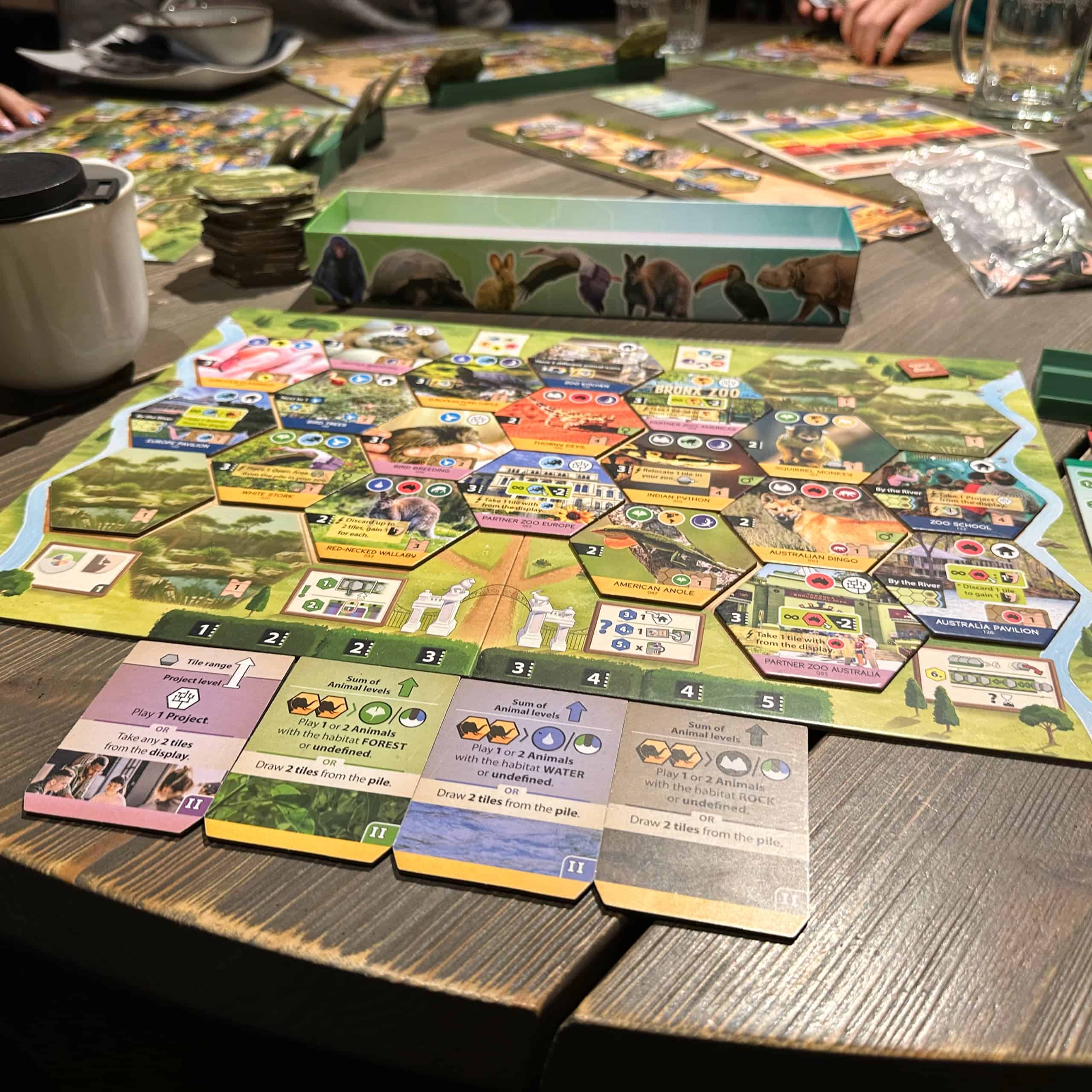
Sanctuary. The light version of Ark Nova might be even better than the original! I initially tried this with my more casual group where playing Ark Nova sounds a bit much. We played Sanctuary with four and five, and both games took two hours. That’s reasonable. A three-player game with my main group took just 45 minutes. Sanctuary is probably better with fewer players, but is definitely playable with five if you don’t mind the downtime. With five fast players it’d take under 90 minutes, which isn’t bad. I think Sanctuary smooths out things well. There’s certainly a luck element on how well the tiles you get match the current game goals, but it’s still an interesting challenge.
Things in Rings. This party game of putting things in rings to form a Venn diagram is very confusing at first, but when it clicks, it’s a lot of fun.
Vantage. I’ve been more understanding for larger player counts on games where I’ve previously thought “less is more”. However, that doesn’t extend to Vantage. This game has 1–6 players in the box, and I’d never play this with more than two. I did have a good time wandering around the planet and our single play produced a nice little story with a good ending. Vantage does clever things with the game mechanisms. I wouldn’t mind playing again, but I also can tell this is a fairly inconvenient game for me.
Good older new-to-me games
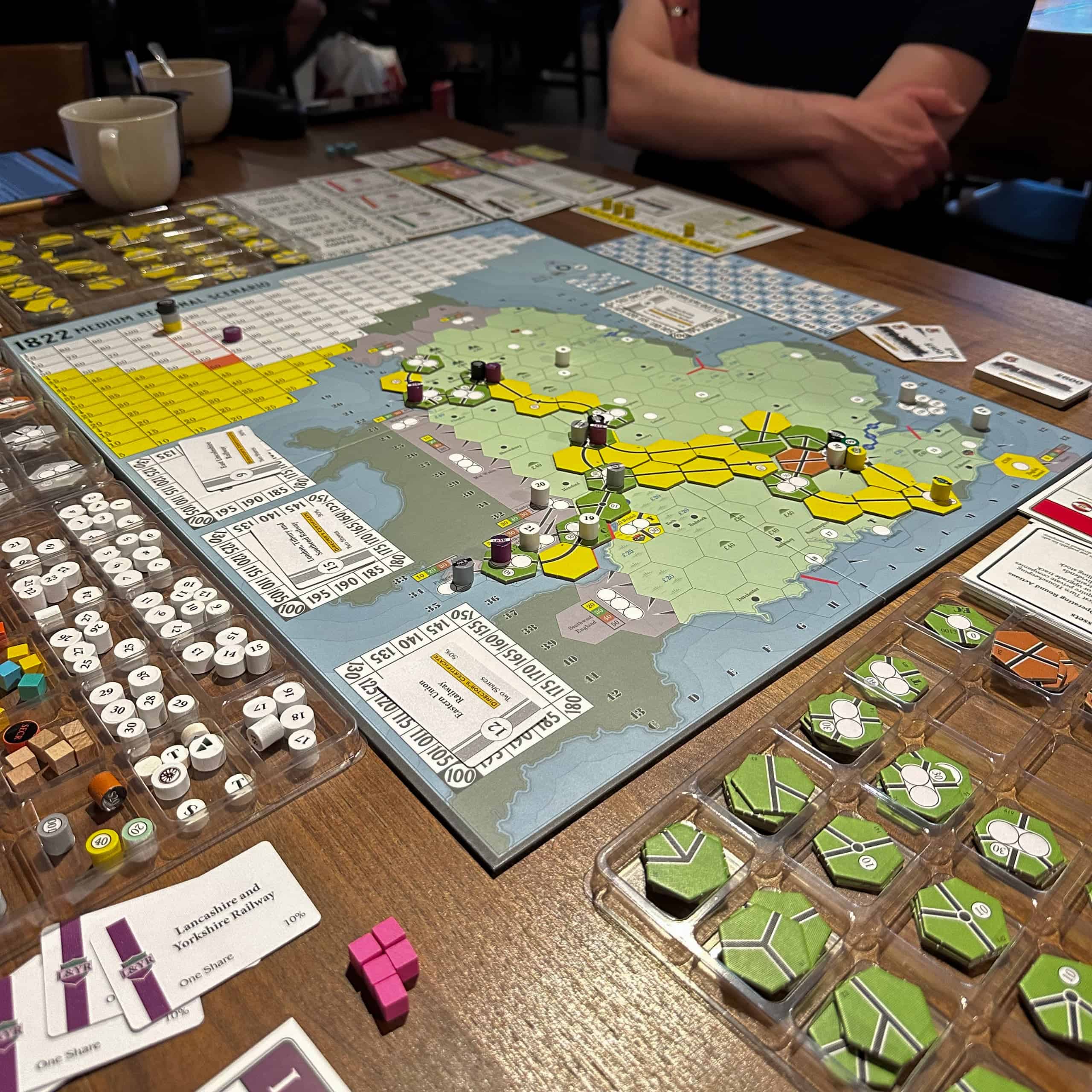
1822CA and 1822: The Railways of Great Britain. We finally dived into the 1822 family. There are many games in the family, but these are the two my friend owns. We’ve played the smaller scenarios, 1822CA twice and 1822 once. I slightly prefer the British game, but that’s just a personal preference for British rails. I was afraid 1822 might have too many auctions, but it doesn’t – a lot of the time the players don’t have enough money to be active. There are certainly many clever and unusual ways to lose in these games. I’m looking forward to exploring these more, and hopefully we can play a full game of one of these at some point.
Cabanga! Small filler card game that works well with four to six players. Simple rules, good interaction.
Faraway. This little filler game has been something of a hit. Draft eight cards, then score them in reverse order. The trick of resolving the cards in reverse order is good enough. The game works well with the whole range of 2–6 players. BGG voters seem to consider this a three-player game and I can see why, but the six-player game isn’t bad, and is almost as fast as the three-player game. With two, this actually feels too fast; it’s just five minutes. I enjoyed playing this, but gave my copy to my son who liked it more than I did.
Great Western Trail: Argentina. Another variation of the cattle game. There are some good ideas here, but I still think this ranks third after the original and New Zealand. I’m happy to play any of these, but I wouldn’t want to teach these games to new players.
Haggis. I learnt that there’s a version of two-player Haggis that can be played with a standard deck of cards. We gave that a go on our cycling trip. The game was a bit confusing at first and we played some rules wrong, but I can see how this is actually a very deep two-player version of Tichu that would reward repeated play.
Herd Mentality. This was released in Finland and won the family game of the year award. That was a bit of an odd choice, but the game has won the best family game, the best adult game and the best party game awards in various countries of Scandinavia. Juries love it, that is, and why not – the idea is clever, the presentation is cute and the game is easy to enjoy.
Piles! This won the party game of the year in Finland. I like fast real-time games, and this is a solid game for that.
Wandering Towers. Kramer and Kiesling deliver another very good family game. Players race around the track, but the track changes constantly, players can get trapped and actually, you want to trap your opponents inside the wandering towers. This was delightful.
Notes on old games
18 BosWash. This magazine variant of 18 India is one of the best 18xx games at the moment. It has all the best parts of 18 India, but is streamlined at the right spots. The designers should consider releasing this as a full game.
18 India. I still like this a lot, too, even though 18 BosWash and 18Korea have been taking up most of the 18xx play time. I still think there’s a lot to learn in 18 India.
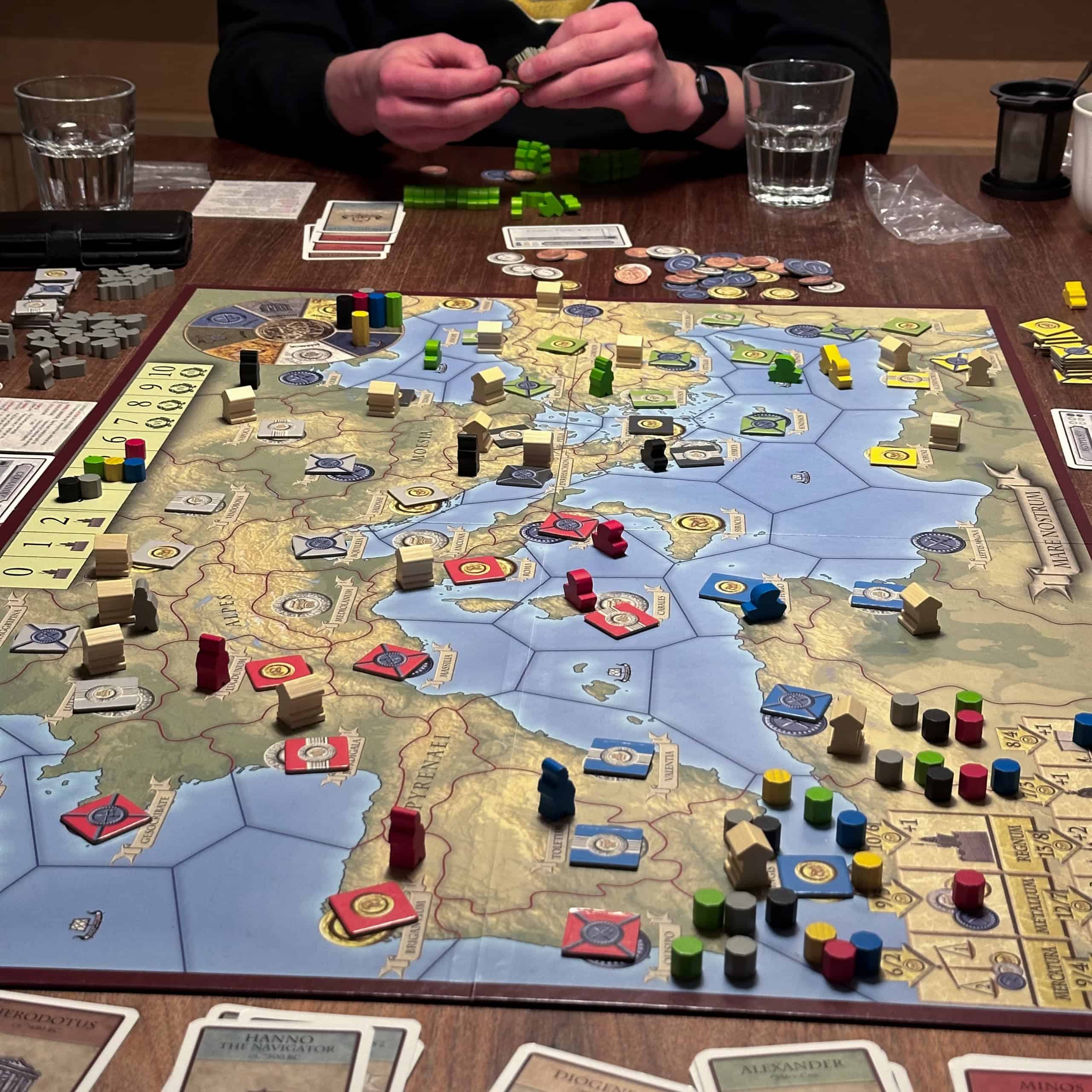
Antike II. After a five-year break, I finally got to play this. Everybody’s been saying no because I’d win for sure, and guess what happened? But in my defense, they did very little to stop me from winning.
De Vulgari Eloquentia. The more I play, the more I enjoy this old-school euro game. There are many strategies and the more we’ve played, the more the strategies unfold.
Dune: Imperium. We played ten games of Dune: Imperium or Uprising in 2024, but I only played it twice in 2025. For some reason, it hasn’t hit the table quite as often.
Fishing. This weird trick-taker is something of a staple game for us now, everybody likes it enough. It can provide some very funny results.
Forest Shuffle. This has been slightly eclipsed by Dartmoor, but I still enjoy playing the original. The Dartmoor still has a much smaller player base at Board Game Arena, so often it takes a long time to find a Dartmoor match while getting a Forest Shuffle match is a matter of seconds.
The Gang. This poker game was a bit of a flash in the pan. After the initial excitement, it hasn’t seen any play. That’s fine, and somewhat to be expected – it’s not a great match for my regular game group, and I rarely play in circumstances where The Gang would shine.
Go. I didn’t play any face to face go in 2025, and I also started to wind down my online play at Online-Go.com. I would like to play more face to face go, but I didn’t have the energy to find new opponents that would match my skill level.
Mahjong. I played one game of riichi with my friends, and didn’t visit the Tuesday night mahjong club once. I prioritized other things. Playing more mahjong would be nice, but the mahjong club wasn’t much fun in the end – some of the players there aren’t as welcoming as they could be.
SETI: Search for Extraterrestrial Intelligence. SETI got many plays for something this heavy. Taverna got a copy of the Space Agencies expansion from Essen, and I’ve played the game twice with the expansion. It’s a good expansion, I like skipping the first round, the agencies are fine and the new aliens are interesting. I’m sure we’ll keep enjoying SETI in 2026.
Tichu. 2025 was a slow year for Tichu, I only played it a few times. It was played more than that in my game group, but I was often playing the other game, SETI or 18xx, which of course isn’t a bad thing. But I’m hoping to play more Tichu in 2026. I went and bought the Tichu app on my phone. I’ve played a lot of Hearts and Spades, and could use some better games.
Troyes. I got to play Troyes again! It’s a lovely game.
Underwater Cities. This is also a great game. We played this once with four players, which was surprisingly smooth. The new Data Era expansion is good, a solid “more of the same” expansion.
The not-so-good, the disappointing and the plain bad
Crime Scene: Moscow 1989. This is a series of escape room mystery games, with extra effort on the storyline written by a professional crime author. The puzzles weren’t bad; some I had to brute force as I couldn’t figure them out. This didn’t impress me, and I’m not interested in exploring other games in the series.
The Number. This was a random pick from the Taverna game library. It’s by Hisashi Hayashi, so it should be interesting, right? Well, it turned out I didn’t enjoy this guessing game at all, it was an annoying exercise of mind-reading.
Tichu: Booster. Special power cards for Tichu. Every time someone calls Tichu, players get new booster cards, which provide one-time effects. What could go wrong? The main problem here is that I’d rather play regular Tichu.
Fives and dimes
- Forest Shuffle: Dartmoor (233)
- Forest Shuffle (100)
- The Fellowship of the Ring: Trick-Taking Game (62)
- Innovation (27)
- SETI: Search for Extraterrestrial Intelligence (14)
- Piles! (10)
- Cribbage (9)
- Slovenian Tarock (8)
Black Forest (8) - Fishing (7)
Faraway (7) - Herd Mentality (6)
- Tichu (5)
Splendor (5)
Cabanga! (5)
18Korea (5)
Year metric
- Battle Line (23/25)
- Innovation (16/16)
- Oregon (15/15)
- San Juan (17/22) *
- Attika (17/23) *
- Carcassonne (17/25)
- Slovenian Tarock (15/19)
- Samarkand: Routes to Riches (14/16) *
- Ta Yü (16/23) *
- Age of Steam (16/23) *
Games marked with an * didn’t get played this year.
Staying power
- Forest Shuffle (6.443)
- Innovation (5.086)
- Mahjong (4.535)
- Slovenian Tarock (4.257)
- Ora et Labora (2.509)
- A Feast for Odin (2.493)
- Great Western Trail (2.3)
- Tichu (2.014)
- Fields of Arle (1.856)
- Forest Shuffle: Dartmoor (1.763)
This is a metric devised by Eric Brosius, and the scores for the games are calculated this way:
For each game and each year, calculate SQRT(number of plays in a year) * (5/6^(current year – year)). Sum these, divide with the sum of year weights, raise to the second power and multiply by the game length in hours.
H-index
My H-index for this year is 8 (9 last year). My total H-index is 53, up one from last year.
I didn’t play any of the games on the edge, but had two new games shoot up from zero to over 53, pushing the H-index. Repeating that is unlikely, as the next step would require five new games above the threshold.
The shortest route to 54 is just six plays, but the games are slightly unlikely (St. Petersburg, Ingenious, Super Rhino, Santorini, and Da Vinci Code or Animal Upon Animal twice). On the other hand, a typical amount of Tichu will lift it close to the threshold in 2026.

One response to “Gaming Year 2025”
All sounds awesome – except the 18xx. 😉